 |
 |
 |
Arrivals – Departures |
|
 |
Athens International Airport – Eleftherios Venizelos |
|
|
|
|
 |
|
|
|
|
Better check the weather... |
|
 National Observatory of Athens National Observatory of Athens |
| Poseidon |
| Ntua.gr |
| Accuweather |
| Weather Underground |
|
|
|
|
|
|
|
|
Villas For Sale in Lefkada |
|
 |
NARCO CONSTRUCTION was formed in order to design and built high standard villas in the area of Lefkada. |
|
|
|
|
|
|
|
|
|
| Skopelos (capital) |
  |
|
|
|
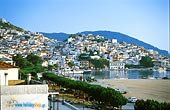 It has about 3000 residents and it is located on the southeastern side of the island. Skopelos is the capital, as well as the main port of the island.
A walk around the narrow streets of Skopelos will give you the chance to admire the traditional architecture of this lovely town. Most houses are stone two-storey constructions, built very close to each other, casting eternal shadows over the cobbled streets in-between. The roofs of the older houses are made of a special stone that used to be very common among the island houses, but can now only be seen in church domes. Another remarkable local feature is the multitude of churches, 123 in total. If you do the math, you’ll soon work out that there’s actually one church for every four houses in Skopelos!
Take a few minutes to admire the beautiful architecture of the capital, a real monument to simplicity and harmony, wonderfully preserved throughout the years thanks to the devotion of the locals.
If you get hungry walking around the narrow streets of Skopelos, there’s many different taverns all over town offering the best in local delicacies. We recommend you try the rabbit (or blackfish) stew, an absolute island classic, and don’t forget the cheese pie - it will blow you away! All these dishes will taste even better with some local red wine (not the bottled kind), quite strong and a bit hard to come by these days. The wine of Skopelos has been known for its heady taste and delicious aroma since the ancient times and, according to the locals, it goes best with grilled plums - another local specialty. |
| |
| Worth seeing |
·The Kastro, which is actually all that’s left of an old venetian fortress. There’s a citadel dating back to the Classical Era below it, along with the walls of ancient Peparithos, parts of which have managed to survive the test of time. The whole area is full of small churches, the most important of which being Agios Athanasios. It dates back to the mid-Byzantine period and it boasts some very well preserved 17th century wall-paintings. It was built over an ancient sanctuary, as was the custom at the time.
·The church of Zoodochos Pigi, built on top of a hill. It boasts a panoramic view and a miraculous, according to some, icon of Archangel Michael.
·The picturesque church of Ai Nikolas (Saint Nicolas) and the equally beautiful temple of Agios Georgios (Saint George) tis Kyratsos with the magnificent cobbled floor. Agios Michail (Saint Michael) Synadontos, Panagia (Virgin Mary) Faneromeni and Agios Michail (Saint Michael) Evnadontas are also worth a visit.
·The house where the famous novelist Pavlos Nirvanas used to live, now open to the public. As you walk through the narrow streets of the capital you will also have the chance to admire some fine local pottery.
·The Folklore Museum in the Fragomachalas neighborhood, showcasing a beautiful reconstruction of a traditional local household, complete with kitchenware, tools and all kinds of useful objects.
·The Monastery of Evagelistria, boasting a unique icon-screen covered in fine golden leafs. It looks a lot like a fortress and it’s built on top of a hill with a marvelous view of the capital. The purpose of this fortified construction was to protect its residents from buccaneer raids. This monastery is closely associated with the wealthy Daponte family, whose marble 1712 proprietary inscription is a testimony to this powerful bond. The first thing you’ll notice as you enter the monastery is the chapel of Agios Nicholaos (Saint Nicolas) on your left, and the kitchen, a stone-built oven and the monastery altar on your right. The monks’ cells with the wooden rooftops take up the four lengths of the precinct walls and the monastery church stands in the middle of it all.
·The church of Kimisi tis Theotokou (Assumption of the Virgin) with the chapel of Agioi Anargyri. It boasts a beautiful wood-cut icon screen decorated with tendrils, birds and various other animals, as well as an inscription of the Great Prayer. It was made by a Cretan called Antonios Agorastos in 1683.
·The Moni (Monastery) of Metamorphosis tou Sotira (Transfiguration), a dependency of the Monastery of Xenodofos in Mount Athos. It is located opposite the Monastery of Evagelistria and - according to the writings of Cyrillus the Second (former patriarch of Constantinople) - it dates back to the 16th-17th century. The monastery was mentioned in one of his books published in 1636.
·The church of Agios Georgios (Saint George) tis Kyratsos with the cobbled floor, boasting religious icons that date back to the16 th-17th century. Agios Michail (Saint Michael) Synadontos is another remarkable temple, whose dominant feature has to be the marble sculptures adorning the walls. Panagia (Virgin Mary) Faneromeni is worth visiting as well. It is decorated with some 16th-17th century icons and bears an inscription over the west entrance reading 1711. |
| |
| Where to swim |
·At Glysteri, a pebbly beach on the north side of the capital. You can either drive there or take a boat out from the port. The Tripiti cave is nearby as well.
·At Agnontas, a beautiful pine-clad beach covered in pebbles, locally known as lalaridia.
·At Panormos, a pebbly beach with impressive turquoise waters. The area also boasts some ruins from an ancient fortifying wall from the Classical Era.
·At Milia, the longest sandy beach in Skopelos, famous for the wild beach parties mostly held there in August. The coastline in this part of the island is absolutely wonderful. Further to the north you will find the beautiful beaches of Elios and Chovolos. |
|
|
|
|
|
|
|
|
|
|
|
|
 |
|
|
|
|
|
|
|




 Choose amazing wallpapers from the holidayshop.gr collection