 |
 |
 |
Arrivals – Departures |
|
 |
Athens International Airport – Eleftherios Venizelos |
|
|
|
|
 |
|
|
|
|
Better check the weather... |
|
 National Observatory of Athens National Observatory of Athens |
| Poseidon |
| Ntua.gr |
| Accuweather |
| Weather Underground |
|
|
|
|
|
|
|
|
|
|
| Patmos or Chora (capital) |
  |
|
|
|
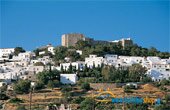 It has about 700 residents and it is located on the south side of the island, 4km away from the port of Skala. It is the biggest city, as well as the capital of the island.
Chora is built around the Monastery of Agios Ioannis (Saint John) Theologos, a mass of beautiful snow-white houses bathed in aegean sunlight. It’s as if all the churches, the pretty manor-houses, the winding streets and the cobbled courtyards brimming with flowers, are all part of a conspiracy to take you back in time. Walk up the old cobbled street of Skala - or better yet hire a donkey to do the work for you - with the old windmills looming in the distance and let the magic of the landscape sweep over you, breathing new life into forgotten legends. Chora is connected to the port with an asphalt road.
|
| |
| Worth seeing |
• The Monastery of Agios Ioannis (Saint John) that looms over the city, immediately capturing the attention of the visitors. It was built in 1088 by the monk-priest Christodoulos Latrinos, following the orders of the emperor Alexios Komninos I΄. The exterior of the monastery is reminiscent of a medieval castle, shielding a well-preserved settlement. The main entrance is located on the northern side. The cruciform church of the monastery was built over the remains of a basilica from the early Christian period. This is where the temple of Artemis is said to have been located as well. The church was built in 1090 and it boasts an intricate icon screen, donated to the monastery in 1820 by the Metropolitan bishop of Sardes Nektarios, who originally came from the island of Patmos.
• The Monastery Library. It is considered to be one of the most important libraries in the world, boasting more than 1100 handwritten codes from the Byzantine period, including emperor Alexios I΄s Golden Bull, concerning the founding of the monastery. You can also admire a collection of mitres belonging to different emperors, the cross of Grigorios V΄ and the unique 11th century mosaic icon of Saint John.
• The Patmiada Scholi (Patmian School), located near the cave of the Apocalypse. It now functions as a seminary.
• The house where E. Xanthos - an educated tradesman who played an important part in the 1821 revolution - used to live, as well as a multitude of historical churches.
• The Cave of the Apocalypse, where Saint John the Evangelist wrote the last book of the New Testament at a very old age, exiled by the roman emperor Domitian in 95 A.D..
• The women-only Monastery of Evagelismos (Annunciation), southwest of Chora.
• The Monastery of Zoodochos Pigi, built in 1607. It boasts the second largest number of nuns in the island.
• The Simadiris manor-house next to the Monastery of Zoodochos Pigi, built in 1625 by a family originally coming from Smyrna. It is decorated with heavy furniture, precious objects, several paintings and russian icons dating back to the 14th-15th century.
• The Town Hall (Dimarchio) built in 1870 in the capital of the island, a fine specimen of neoclassical architecture.
|
|
|
|
|
|
|
|
|
|
|
|
|
 |
|
|
|
|
|
|
|




 Choose amazing wallpapers from the holidayshop.gr collection