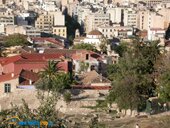
•The Acropolis, dominated by the Parthenon. It has been deemed one of the most important archaeological sights in the world thanks to its history and high architectural standards. The construction of the Parthenon was ordered by Pericles and the architects in charge of the project are given as Iktinos and Kallikrates (447 - 438 B.C), however creative supervision was given to Pheidias (438 - 432 B.C.) The Parthenon was dedicated to the goddess Athena, whose statue was featured in a very prominent position. The Acropolis suffered a lot of damages from venetian (1678) and turkish raids. Nowadays, visitors can admire the Parthenon, the Erechtheion (a sanctuary, a grave, and a ceremonial place at the same time) and the Caryatids, which have now been placed in the Acropolis Museum in order to be protected from atmospheric pollution, along with a large selection of masterpieces from different temples (that have now been completely wiped out) discovered in the homonymous archaeological site.
•Hadrian’s Arch, one of the most characteristic monuments of the Roman period ever to be built in the city of Athens. It has become a national landmark, quite inseparable from the urban landscape. It is 18 meters high and towers over Amalias Avenue, separating the old part of the city from the new. It is a triumphal arch, built according to the roman prototypes that were spread throughout the Roman Empire. It was constructed by the Athenians in honour of the Emperor Hadrian, their city benefactor, who inaugurated it himself in 131 A.D. during a visit to Athens. Hadrian’s Arch was always independent and self-existent, never comprising a part of the city’s fortification walls or of any other greater construction. It consists of a wall made of Pentelic marble with an arched opening supported by pilasters, crowned with Corinthian capitals. Similar, but taller pilasters flank the outer corners. The arch is crowned by a series of Corinthian columns and pilasters, with an Ionic architrave at the ends, and an entablature with a triangular pediment in the middle. There were two inscriptions carved on the architrave, one on each side. The one facing the Acropolis reads “This is Athens, the ancient city of Theseus” and the side facing the Olympieion reads “This is the city of Hadrian and not of Theseus”. Apparently there was a new section added to the ancient city during the period of the Roman peace, often referred to as Hadrianopolis.
•The Ancient Agora, located below the Sacred Rock of the Acropolis. It used to be one of the city’s most famous public spaces, hosting numerous commercial, financial and religious activities. Every self-respecting Athenian owed it to himself to look in on the Ancient Agora at least once a day. It was also the place where all public service buildings and court houses were located. The most important monuments of the Ancient Agora are the Hephaesteo, which is mistakenly called Theseo (a temple dedicated to Athena and Hephaestus), the gallery of Attalos (housing the Museum of the Ancient Agora), Tholos (the headquarters of the rectors), the Parliament House (few traces remain), the Odeion of Agrippas and Mitroo.
•The Theater of Dionysus, located east of the Acropolis, once dedicated to the god Dionysus. The tyrant Pisistratos had chosen it for the annual celebration of a festival called the Greater (or City) Dionysia, and it is considered responsible for the universal establishment of the dramatic arts. It hosted tragedies written by the three greatest dramatic poets in antiquity, Aeschylus, Sophocles and Euripides, as well as comedies by Aristophanes. Visitors can still admire the ruins of the ancient temple as well as the theater itself. t takes up the southeastern slope of the Acropolis and it can be accessed from the pedestrian walk of Dionysiou Areopagitou Street or by metro (make sure you get off at metro stop ‘Acropolis’). The area it was built in was a place of worship dedicated to the cult of Dionysus in the 6th century B.C., protector of the dramatic arts. The ancient drama in those days had not yet settled into a standardized form like it has today, and the performances used to take place in a specially modified space near the Ancient Agora. During the 5th century there was a special circular spot set up for the audience near the temple of Dionysus. However the monumental theater one sees today was built in the 4th century B.C. and was part of the construction program of the orator and politician Lycourgos (330 B.C.). The Theater of Dionysus had an orchestra with an altar right in the middle, same as all ancient theaters, a parodos, a skene (stage) and a cavea that was divided horizontally into three sectors by two diazomata. The thirteen tiers of the lower level of the vea were intended for the ten Athenian tribes and other special guests. The officials’ seats were located in the first two rows, same as in contemporary theaters. During the second century B.C. those seats were replaced by marble thrones that were intended for the sacerdocy and the high priest of Dionysus Eleutherios, who occupied the most honorable seat of all. We can trace six different construction phases within the theater, which the wealthier citizens and emperors never seemed to stop embellishing. During the years of the Roman domination the proscenium was extended and decorated with relief representations preserved to this day. The theater could seat up to 16.000 spectators Even though the Theater of Dionysus was used for Dionysian rituals and dramas, it is more famous for hosting functions of social character rather than anything else. During the 4th century the meetings of the. Ecclesiae of the Demos (previously held in Pnyka) were moved there too because of the theatre’s great capacity. During the Roman period it even hosted hunts, mock naval battles, gladiator fights and spectacles that had nothing to do with the sacred institution of the ancient drama.
•The sanctuary of Aesculapius next to the Theater of Dionysus and the Gallery of Eumenous (built in the 2nd century B.C.)
•The Aeropagus (Areios Pagos), a relatively low rocky hummock situated on the west side of the Acropolis with steep steps leading up to it, chiselled on the south-eastern side of the hill. Its name makes it fairly obvious that it was dedicated to Ares, the god of war, or to the Erinyes (Furies), the ghastly deities of revenge. This was also a place of worship dedicated to the cult of Boreas and the Amazons, Ares’ daughters. During the Archaic period the legislative and judicial council of the aristocracy decided to assume the name of Aeropagus and it is quite possible that they used the hill as meeting grounds as well. However there are no ruins left to verify this assumption. The surface of the hill is uneven and completely unsuitable for any kind of monumental construction. The only thing that remains standing on the plateau of the rocky hummock is a big boulder in the shape of an altar that is assumed to have been dedicated to Athena. There must have been more than one cult established up there, which is very common with all of the hills surrounding the Acropolis. Today most people associate the Aeropagus with Christian worship rather than ancient religious practices because, according to the Acts of the Apostles, this is where the Athenians led the apostle Paul to do his preaching in 54 A.D. His success was questionable because his audience was more used to hearing philosophers and orators rather than people preaching the ways of the Lord. According to the Gospel some were sneering while others wanted to hear more. Nevertheless, he managed to convert two Athenians, Dionysios Areopagitis and a woman called Damaris, who became the first Christians in the city.
•The Odeion of Herodes Atticus, located near the right approach to the Sacred Rock, on the south slope of the Acropolis. Odeia in the ancient times were amphitheatrical spaces covered with roofs that hosted musical contests and hearings. It is made clear by the name that it was financed by Herodes Atticus, an eminent citizen of Athens, in loving memory of his wife Regilla, and was erected sometime after 162 A.D. During the Roman period the architectural form of such constructions was already standardized. They looked just like theatres with a skene, an orchestra, tiers and parodoi. Often the only difference between them was the fact that some had roofs while others didn’t. The cavea of Herodeion made use of the natural hillside and had two diazomata separated in tiers. The wall of the skene comprised the façade of the monument, which is still visible from Dionisiou Areopagitou Street. It is one of the most impressive constructions ever to survive the test of time, 30 meters high with statues standing tall in their niches. The odeion could seat up to 6.000 spectators. Its roof, according to ancient sources, was made of cedar. It was undoubtedly the main odeion of Athens, taking the place of an older one that used to be located in the Agora. It is fairly possible that the roof collapsed after the city of Athens was invaded and ransacked by the Herulae in 267 A.D. Today the odeion of Hedores Atticus is fully renovated and open to visitors. During the summer months it hosts the musical and theatrical activities of the Festival of Athens, recovering some of its long lost glory.
•The archaeological sight of Kerameikos, where visitors can admire the remains of the ancient cemetery of Athens. It was a place of burial exclusively reserved for the most important citizens of the Athenian State, in order to set an example for the younger generations. Kerameikos is believed to have been the place where the eulogy of Pericles was delivered after the first year of the Peloponnesian Wars was over. Besides the numerous graves, the sarcophagi and the grave steles, visitors can also admire part of the Themistocleian wall, as well as the Dipylon and the Sacred Gate (two of the most important gateways to the ancient city of Athens), the Pompeion (used for the preparation of the Panathenaea procession) and the Museum of Kerameikos. The Museum’s most important exhibits are naturally the funeral gifts discovered in the surrounding graves.
•The Philopappos Monument, located on the Museio Hill (commonly known as Philopappou) on the south-eastern side of the Acropolis. Its ancient name makes it fairly obvious that there must have been some sort of shrine dedicated to the Muses there, even though Pausanias assures us that it was really a monument in the memory of the musician Musaios. The hilltop was surrounded by fortification walls erected by Demetrius the Besieger, pretender to the Greek throne, in 294 B.C. Today the most important temple crowning the hill is the funerary monument of Philopappos that contains his burial chamber, visible from all the surrounding areas and a familiar feature of the urban landscape. This monument was built around 115 B.C. in honour of Julius Antiochus Philopappos, the grandson of the last king of Commagene, a Syrian kingdom that was abolished by the emperor Vespacianus in 72 A.D. Philopappos was probably expatriated and sent off to Athens in a more refined form of exile, where he settled down and was granted full citizenship. Being the wealthy offspring of a royal family, he became a great benefactor of the city and in return the Athenians allowed him to build his funerary monument on top of the Mouseio Hill, right across the Acropolis - a very honorary spot. The monument is made of white Pentelic marble and faces the Sacred Rock of the Acropolis. The frieze bears a relief representation of Philopappos on a chariot while on a second level, right above the chariot, there are two niches with the seated statues of Philopappos and his grandfather, king Antiochus, that still remain in good condition. The two figures are surrounded by inscriptions in Latin and Greek recording the names and the titles of the persons represented. The grave of Philopappos itself was in a sarcophagus behind the façade with the niches, on the same level with the monument’s podium. The whole construction is more than 12 meters high.
•The Roman Agora, located in the heart of Plaka, next to the Tower of the Winds. It was a vast open space, 110 meters long and 98 meters wide, made to look like a spacious peristyle courtyard, only indoors. The commercial centre of Athens, that used to be housed in the Ancient Agora a few hundred meters to the west, was moved to this specially modified space during the reign of Augustus. It is estimated that the construction of the Agora must have been completed by 10 A.D. Today the Agora is only half excavated and only partially open to visitors. It was accessible from two monumental entrances, one of which - commonly known as the Gate of Athena Archegetis - is preserved in very good condition. It has the form of a propylon with four Doric columns (eight meters each) and an epistyle, bearing inscriptions with the names of Julius Caesar and Augustus who gave this monument to the people, as well as a dedication to the patroness of the city, Athena Archegetis. The construction was actually founded by Augustus alone, making it look like Julius Caesar was involved too and the special mention to Athena could be an indication that there was a shrine in her honour somewhere nearby. The Roman Agora was shaped like a great atrium with an Ionian peristyle surrounded by stoas, shops and storerooms. The stores were all assembled on the eastern side of the Agora, and were really just rooms of equal size, sublet by the city. Try to imagine the centre of the Agora as an indoors marketplace that must have looked a lot like today’s street markets. A spring on the south side catered to the people’s needs for drinking water, while the public lavatories were right outside the east entrance. The Roman Agora, contrary to the Ancient Agora of Athens, was built for this purpose from the start, carefully planed and standardized to house the commercial activities of the city.
•The Temple of Zeus Olympios, one of the oldest and most important sanctuaries in Athens. In the beginning of the 6th century B.C. there used to be another temple dedicated to Zeus in its place, but in 515 B.C. the tyrant Pisistratos the Younger decided to build a bigger one - similar to the temples that had been erected in Asia Minor during that same period. The plan was never realized and it seems to have been abandoned at a very early stage, possibly due to the establishment of democracy in the city of Athens and the political reform that ensued. In all probability the Athenians did not want to go through with a project that would inevitably be associated with tyranny. Later on, during the period of the Medeans, part of the construction material was incorporated in the fortification walls of Athens, built by Themistocles. Archaeologists have discovered some huge flywheels (two and a half meters wide) that were said to have come from that first attempt to erect the sanctuary. It was obviously going to be quite grand, meant to overshadow all others. The project was finally given the go-ahead many centuries later with the financial backing of Antiochus IV Epiphanes, the king of Syria (175 - 163 B.C), in an attempt to make a place for himself in the Greek history. The new plans were drawn up by the Roman architect Cossutius but unfortunately Antiochus died before the temple was finished. Vitruvius mentions that it was an open air construction (i.e. with no roof), which explains its size and the architectural restrictions that had to be overcome when dealing with such a large scale plan. It is said that during the sack of Athens, lead by the Roman general Sulla in 86 B.C., many columns were snatched from the sanctuary and taken to Rome to be used in the temple of Zeus in the Capitolium. All thoughts of the monument were abandoned for two more years until Hadrian, a Roman Emperor and a great lover of Greece, took it upon himself to see it through. The project was completed in five years time and the Emperor himself was present at the inauguration ceremony. The temple was of Corinthian order, tripteral octastyle on the two narrow sides, and dipteral eikosastyle on the long sides, with a colossal chryselephantine (gold and ivory) statue of Zeus in the cella. There was also a statue of Hadrian himself, worshiped as a god by the Athenians. He also financed the big rectangular precinct outside, which is preserved in excellent condition. The temple was surrounded by 104 Corinthian columns in total, only 13 of which survived the test of time. Unfortunately one of them fell and broke in tiny little pieces after a violent storm in 1852. The temple itself collapsed in the late Archaic period, possibly due to the great earthquakes in the 4th and the 5th century A.D. During the Middle Ages the locals used to melt the marbles of the sanctuary in the fire in order to prepare whitewash. In the last years of the Turkish domination, a monk went and set up his cell right on the epistyle. Its remains – still visible in the days of King Otto - were depicted in the gravures of many traveling artists.
•The Pnyx,located on a hill west of the Acropolis, right across the Aeropagus. Being the meeting place for the Ecclesiae of the Demos - the Assembly of the Athenians that made all the important decisions - it is a monument of great importance for the history of Greece. This is where democracy was conceived and realized for the first time. The fact that it was also a place of worship dedicated to the cult of Zeus Agoraios, protector of the constitution, wasn’t just mere coincidence. The Ecclesiae of the Demos met ten times a year. The head of the rectors presided over all the meetings with the help of a secretary and a herald, who made all the announcements. In the 5th century B.C. the public used to sit on the rocks and later on wooden benches. The lowest level of the bema (podium) was meant for the rectors responsible for preserving the order with the help of a few armed guards. This bema was used by many great men and orators who wished to address the public. The speakers included Themistocles, Pericles, Alcebiades and Demosthenes. There are three construction phases traced within the monument. During the first, that dates back to the early years of the Athenian Democracy (around 500 B.C.), the monument could seat about 5.000 people. The bema was placed north of the cavea and the spectators were facing the Agora and the Aeropagus. During the second construction phase that dates back to 400 B.C., the bema was moved to the northwest and a retaining wall was built on the north side with two stairway approaches on the Agora side. This way the capacity of the monument was increased and it could now sit 6000 people. During the third phase, which chronologically coincides with the ambitious construction program of Lycourgos (330-326 B.C.), the capacity of the cavea was increased by 7.500 people with the addition of the new monumental retaining wall. The bema, which is preserved to this day, was right across the entrance, chiselled on the natural rock, and consisted of three levels. The monument was abandoned at the end of the 4th century B.C. when the meetings of the Ecclesiae of the Demos were transferred to the Theatre of Dionysus on the south slope of the Acropolis.
•The Choregic Monument of Lysikrtes, located in the heart of Plaka, on the east side of the Sacred Rock. It is preserved in excellent condition and consists of a circular building in the shape of a peripteral tholos supported by six Corinthian columns, resting on a square podium of poros stone. The entablature is of Ionian order bearing an inscription of the choregos (financier) and a frieze with relief representations of incidents from the adventurous life of Dionysus. The conical roof used to be crowned by the choregic tripod, awarded to the choregos of the tragedy that triumphed in the Greater (or City) Dionysia (drama contest). Monuments of this kind were quite common in Athens during the Classical Era. According to Pausanias, the so-called Street of the Tripods that began in the Agora and went winding around the north and the east side of the Acropolis ending up in the Theatre of Dionysus, was studded with similar monuments shaped like small temples. Those monuments were a way of showing the choregic tripods - given as drama contest awards - to the world. The excavations around the Acropolis revealed the remnants of many such constructions but the choregic monument of Lysicrates is the only one that remains almost intact. We also know the exact date of its erection thanks to the mention of Evainetos in the choregic inscription, ruling archon of Athens from 334 to 333 B.C. During the Turkish domination the monument was incorporated in a Capuchin monastery, which helped preserve it to this day. There has been some restoration work done in 1845 and in 1892, but it was very limited.
•Hadrian’s Library, an impressive complex located in Plaka, a few meters north of the Roman Agora, not far from the homonymous train stop. It is the work of Emperor Hadrian, the great benefactor of Athens, who wanted to create a peaceful spot near the bustling bazaar, a place for reflection and pondering. The ground plan of the library complex was very similar to that of the Roman Agora, making one wonder whether it was Hadrian‘s intention to juxtapose the social character of Augustus’ creation with a structure that addressed the inner man. The complex comprises of a huge atrium surrounded by four arcades looking onto the open peristyle courtyard. This rectangular building is 82 meters wide and 122 meters long with a Corinthian propylon on the west side. There is an impressive colonnade running down the façade, which happens to be the best preserved part of the whole monument. In the middle of the courtyard – try and picture it as strolling grounds – there was an oblong reservoir that probably used to be a fountain. There are three projecting conches on each of the long sides, ideal for quiet talks away from the sun. The library itself was situated in a vast central hall on the eastern side of the complex, surrounded by two smaller rooms, possibly studies for visitors. On each side of the eastern wing there were two halls with successive rows of stone benches, correctly assumed to have been lecture halls. Pausanias visited the library a little while after the construction was completed and said of its luxury: «There are halls of alabaster with gilded ceilings, decorated with statues and paintings. And these halls contain books». It’s easy to imagine elderly scholars studying the papyruses and the parchments of the great Classics and taking relaxing strolls in the atrium’s garden while discussing the latest philosophical theories. Hadrian’s library remained an oasis for the intellectual for more than 130 years, until it was destroyed by the barbarian Herulae during the sack of Athens in 267 A.D.
•The Tower of the Winds, one of the most renowned landmarks of Plaka and one of the best preserved monuments in the whole city. It was also known as Horologion of Andronicos, named after the Syrian architect and astronomer Andronicos Kyrrestes from Kyrrhos, who was responsible for its construction. It is a relatively small octagonal building considered to be part of the Roman Agora, with an elaborate waterclock on the inside. On top of its conical roof there was a bronze Triton vane that indicated the direction the wind was blowing from by pointing his wand at one of the eight winds depicted on the upper part of each of the eight sides. The winds are relief representations of male figures, each with the appropriate attributes. Their names are engraved under the corresponding part of the octagonal eave: Boreas (North), Skiron (North West), Zephyrus (West), Lips (South West), Notos (South), Euros (South East), Apeliotes (East) and Kaikias (North East). Each corner of the tower also sports a sundial, an iron bar that sheds its shadow on specially engraved lines. On a day without sun one can still keep track of time thanks to the hydraulic invention of Andronicos. The Roman architect Vitruvius mentions the monument as Tower of the Winds. It is preserved in excellent condition, mainly because during the Turkish domination it was turned into a Tekke, i.e. a dervish chapel.
•The greatest monuments of the Byzantine period. The most significant Christian temples to survive the test of time are the churches of Agioi Theodori next to Stadiou Street, Panagia (Virgin Mary) Kapnikarea (Ermou Street), Agioi Apostoli (build during the 11th century), Sotira Likodimou (dating back to the 11th century as well), Agios Nikolaos (Saint Nicholas) Ragavas (11th century) etc.
•The Acropolis Museum (tel. 210 3210219), boasting several priceless exhibits. It is considered one of the most significant museums in the world.
•The National Archaeological Museum (tel. 210 8217717) on Patision Street. It hosts numerous exhibits from all the different periods of Ancient Greek Art.
•The Byzantine and Christian Museum (22 Vasilisis Sofias Street)
•The Benaki Museum (tel. 210 7228321). Art lovers should also visit the National Gallery (tel. 210 7211010).
•The Panathenaic Stadium (Kalimarmaron) that hosted the first contemporary Olympic Games in 1896.
•The Lycabetus Hill looming over the centre of the city with the little church of Agios Georgios (Saint George) on top and an open theatre at the back.
•Syntagma Square, featuring the Parliament House and the National Gardens right next to it. It’s one of the busiest spots in the city, offering visitors the chance to rest, take a walk or a have a quick and refreshing drink.
•The Metro, one of the most modern subway systems in Europe. One of the most important stops along the way is Syntagma, where the public can admire several archaeological exhibits discovered during its construction.
•The picturesque Plaka, the old and most popular part of Athens. It still preserves a very traditional flavour reminiscent of times gone by, featuring lots of coffee houses, taverns and folk art shops. |




 Choose amazing wallpapers from the holidayshop.gr collection