|
 |
 |
Arrivals – Departures |
|
 |
Athens International Airport – Eleftherios Venizelos |
|
|
|
|
 |
|
|
|
|
Better check the weather... |
|
 National Observatory of Athens National Observatory of Athens |
| Poseidon |
| Ntua.gr |
| Accuweather |
| Weather Underground |
|
|
|
|
|
|
|
|
|
|
| Kerkyra or Corfu (capital) |
  |
|
|
|
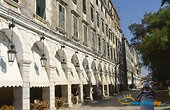 One of the most beautiful cities in the Mediterranean Sea. The old part of the city lies between two venetian fortresses. Corfu, which is Latin for Kerkira, is a variation of its old place-name Korifo, inspired by the two korifes (peaks in Greek) of the Old Fortress which surrounded the city. The magnificent and grandiose Kerkira owes all its splendor to its european influences, having been the crossroads between many different civilizations. Its cultural identity is the result of the creative combination of various characteristics. The outcome is a harmonious sense of rhythm and culture which goes beyond the traditional greek flavor and charms the visitor with its uniqueness, taking him into a different european dimension. One of the most beautiful cities in the Mediterranean Sea. The old part of the city lies between two venetian fortresses. Corfu, which is Latin for Kerkira, is a variation of its old place-name Korifo, inspired by the two korifes (peaks in Greek) of the Old Fortress which surrounded the city. The magnificent and grandiose Kerkira owes all its splendor to its european influences, having been the crossroads between many different civilizations. Its cultural identity is the result of the creative combination of various characteristics. The outcome is a harmonious sense of rhythm and culture which goes beyond the traditional greek flavor and charms the visitor with its uniqueness, taking him into a different european dimension. |
| |
| Worth seeing |
•The Liston, an impressive building complex northwest of the central square Spianada (Esplanade), which was constructed during the French period, combining both french and venetian architecture (similar buildings of the same style and era can be found in Paris, e.g. in Rue Rivoli). It's worth mentioning that the Liston got its name from the famous list Libro d’Oro, which included many noblemen of the time. They had the privilege of being the only ones allowed free access to the area.
•The square Spianada itself, constructed similarly to the Royal Gardens of Europe. It is the biggest square in the Balkans and one of the most impressive ones in the whole continent. It features venetian fountains, an ancient aqueduct and a beautiful pavilion that hosts the activities of the local philharmonic bands during the summer.
•The Old Fortress, built around 100 meters east of the Spianada, right on a small peninsula. It was constructed during the Venetian occupation in mid 16th century and was cut off from the shore by an artificial dike, called Contra Fossa. This is where the local army managed to check the enemy advances of the muslin forces under the command of Scholemburg (there is a statue in his honor at the entrance of the Old Fortress). It symbolizes the salvation of Europe from the Ottomans. The most important edifices inside the Fortress are the old english barracks and the church of Agios Georgios (Saint George), also built by the English, which happens to be the only orthodox church in the world built in Dorian order.
•The New Fortress, which dominates the western part of the old harbor, built between 1586 and 1589 by the Venetians. Its walls are decorated with engravings of the emblem of the Venetian Democracy: a lion of Saint Marcus holding the Gospel and seven arrows, which symbolize the Eptanisa (the seven Ionian Islands).
• The mansion of Agios Michail (Saint Michael) and Agios Georgios (Saint George), which used to host the homonymous monastic order as well as the English Commissioner’s headquarters. It was built between 1818 and 1823. In front of the palace gardens there is a statue of Adams, the Commissioner who built the irrigation and drainage systems, according to the english prototypes. Not only does his system survive to this day but it is still in use, proving how valuable his contribution was and explaining why the square in front of the palace bears his name.
•The church of Panagia tis Mandrakinas (Virgin Mary of Mandrakina), next to the Boschetto Park.
•The Kato Platia (that’s how the northern part of the Spianada is called) where you can find what is considered to be the most picturesque cricket field in the world, with the Liston looming above it on one side and the Old Fortress on the other. Kerkira is the only place in Greece where cricket is played.
•The Boschetto Park is a true gem, brilliantly green, brimming with flowers and fountains. In this beautiful garden, among the many decorative busts you can easily spot the English Commissioner Guilford’s, one of the most important personalities in the history of Kerkira. He was the man who founded the Ionian Academy in co-operation with Ioannis Kapodistrias. It was later going to become the first University in Greece (unfortunately it was transferred to Athens leaving Kerkira bare of its cultural heritage)
•The building of the Ionian Academy, of venetian architecture, which is situated in the Spianada square. It was bombed by the Germans in 1943 and part of it was reconstructed and renovated in 1995. In front of the Ionian Academy, in the middle of a small park, looms the statue of the first governor of Greece, Ioannis Kapodistrias.
•The Town Hall square, with its many magnificent buildings like the Town Hall itself.
•Kardaki with its beautiful spring, which is said to have been the place where Ulysses met Nausica, the daughter of King Alkinoos. According to tradition, whoever drinks water from the spring instantly forgets where he came from and stays in Kerkyra forever.
•The monument of the English Commissioner Douglas (known as the Douglas column) as well as the Menekratis Monument.
•The Archaeological Museum (tel. 26610 30680)
•The Museum of Oriental Art (tel. 26610 30443)
•The Museum of Byzantine Art
•The church of Agios Spiridonas, where you can also visit his relic
•The church of Agios Iasonas (Saint Jason) and Agios Sosipatros (11th century), which is the only church of Byzantine Order in the whole island (all the rest are Basilicas)
· The Moni (Monastery) of Platiteras, where you can visit the grave of Ioannis Kapodistrias
· The Basilica of Palaiopolis in Mon Repo, built right on the site of a 5th century temple
· The Monastery of Agioi Theodoroi (6th century) |
|
|
|
|
|
|
|
|
|
|
|
|
 |
|
|
|
|
|
|
|




 Choose amazing wallpapers from the holidayshop.gr collection