|
 |
 |
Arrivals – Departures |
|
 |
Athens International Airport – Eleftherios Venizelos |
|
|
|
|
 |
|
|
|
|
Better check the weather... |
|
 National Observatory of Athens National Observatory of Athens |
| Poseidon |
| Ntua.gr |
| Accuweather |
| Weather Underground |
|
|
|
|
|
|
|
|
Villas For Sale in Lefkada |
|
 |
NARCO CONSTRUCTION was formed in order to design and built high standard villas in the area of Lefkada. |
|
|
|
|
|
|
|
|
|
| Parikia - (capital) |
  |
|
|
|
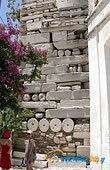 With 3000 residents, it is located west on the island and is the capital and the main port.
The Byzantines could never have imagined that an island that encapsulated their fear and pain would become the island of relaxation and entertainment. As collateral, they left Parikia with the lovely back streets, the archways, the terraced lands, and the castle (whatever remains of it). Today locals have decorated their windows and balconies with fragrant basil and geraniums, jasmine and bougainvillea.
All that remains is to check in our mood and the atmosphere becomes magical. |
| |
| Worth seeing |
•The castle, constructed by the Duke of Naxos, Markos Sanoudos in the 13th century AD has a number of parts still standing. Within the neighbourhood of the castle, on the hill of the Acropolis of Parikia, existed the ancient temple of Demeter, or according to some, Athena’s temple. The former is more likely considering Naxos was known in early days as ‘Demetrias’. An ancient town from the 3rd century BC was discovered near the temple. Located near the castle are 10 churches, with that of Agios Constantine being the most significant amongst the ten.
•The Temple of Apollo at Delios, dedicated to Artemis of Delos is definitely worth a visit.
•The Archaeological Museum in central Parikia with rare specimens from the 16th century BC and Neolithic findings from the small isle Saliagos off Antiparos (4000 BC). Of especial value is the sculpture of the poet Arhilohou, part of the famous ‘Parian Chronicle’ describing the history of the island (16th - 13th centuries BC). Also part of that group is the statue of Nike of Paros (5th century BC), the Mosaic Hercules, and others.
•The home of the heroine of 1821, Mando Mavrogenous, located close to the Archaeological Museum.
•The remains of the Asklipiou, 1 km from Parikia along the way to Aliki and the temple of Pithias is worth a stop and a visit.
•The ancient cemetery by the seashore of Parikia is an interesting visit.
•The monastery of the Agion Anargyron, located at the highest point of Parikia.
•The monk Paleologo built the monastery Loggovanda, in 1638 AD. It faces Naousa to the north and has a historic library. Entrance is forbidden to women.
•On your way to Aliki, you may wish to visit the nunnery of Christ of the Forest, - just follow the southern route. The three monasteries of Paros are full of sentiment and are liable to stir up strong emotions as they blend the beautiful architecture with the deep feeling of devout concentration.
•The church of the Panagia Septemvrianis has a bust of the Virgin from 1592 AD
Agios (Saint) Constantine sits commandingly in the ancient temple of the castle.
•The Venetian Church of Christ remains at the same location.
•The churches of the Panagia of the Holy Cross (1514AD) Agia Marina, Agia Anna, Agia Aikaterina and the church of the Annunciation.
•One of the greatest Byzantine monuments of Greece is the church of the Panagia Ekatondapyliani. There are many versions regarding the origin of its name. One is that the real name is ‘Katapoliani’ a derivative of ‘kata tin poli’ meaning facing the town, as the church does face the ancient town. The other version derives the name from the hundred doors and arches the church has. Ekato = hundred. According to Byzantine records, Ekatodapyliani was constructed in the 4th century AD on behalf of Saint Helen, who on her journey to the Holy City to find the Holy Cross visits Paros. Praying in a small temple dedicated to the Assumption of the Virgin, vows to return and build a majestic temple in place of this small one, if she finds the Holy Cross. Another version has Constantine the Great, constructing the temple - realizing his mother’s vision. There have been many additions to the original structure, yet it remains true to the style from the age of Justinious. Over the years, it was ransacked and destroyed by both the Franks and the Turks. Restoration of the church began in 1959 and decorated with carvings from the Temple of Demeter as well as with other historic icons. Take especial note of the icon of the Panagia Amolyntou (16th century AD) according to local tradition it is the work of the Evangelist Luke.
Visit the tomb of ‘Osias Theoktistis’ (Blessed builder of the Lord) canonized on the island, and the Panagia Ekatopyliani (17th century AD) a dedication by the benefactor of Moldovlahias Nicholas Mavrogenous. Within the church grounds, there are engravings from other ages such as the tomb of the heroine of the revolution of 1821, Mando Mavrogenous.
•See the ‘Butterflies’ - Petaloudes - in the fields Psychopianon, 6km south of Parikia, which can only be described as a dream. In spring and summer, thousands of butterflies with their wonderful colours decorate an area of cool water and rich vegetation such as bushes and ivy, as well as beautiful flowers. |
| |
| Where to swim |
| •There is no ‘best’ beach to enjoy as they all offer exceptional pleasure. As an indication of some of these wonderful beaches – Agia Irini, Kaminia, Krios and Agios Fokas are better protected from the winds. Parasporos and Agia Irini cater to nudists. All are accessible by car and by boat. |
|
|
|
|
|
|
|
|
|
|
|
|
 |
|
|
|
|
|
|
|




 Choose amazing wallpapers from the holidayshop.gr collection